
2025 · SaaS · Booking
Boek met Mij
It started at my barber’s chair. He only took appointments by phone, so every ring meant putting down the scissors, walking to the desk, and scribbling times on paper. I built Boek met Mij so clients could book online and he could stay focused on the cut.
boekmetmij.nl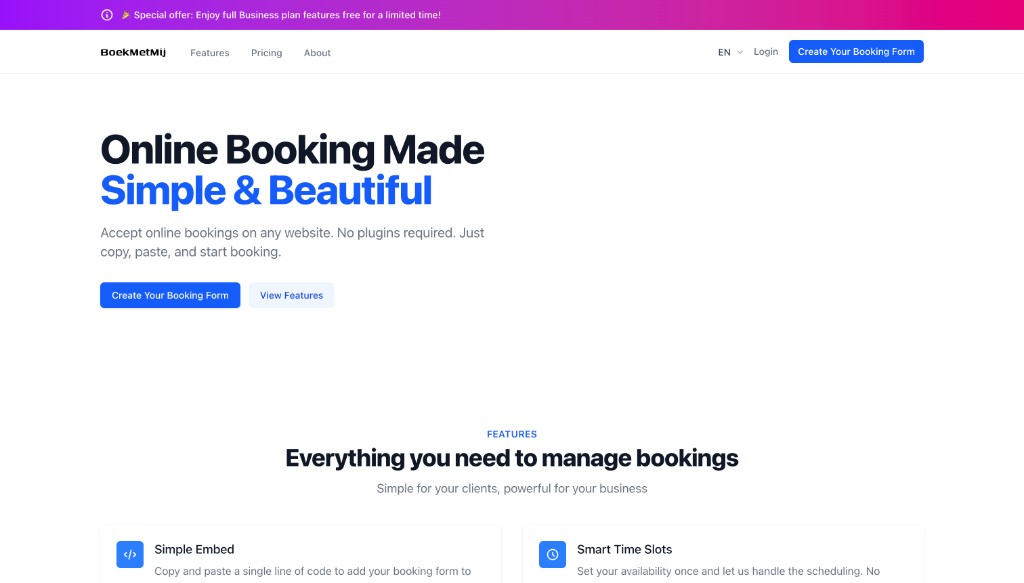
One product for businesses that already have a website and for those who do not.
What I built
Boek met Mij is online reservation software for small service businesses: barbers, salons, groomers, consultants, anyone who works from a calendar. Each business sets up services, durations, opening hours, buffers, and who on the team can be booked. Customers pick a treatment, a day, and an open slot, leave their details, and get confirmation by email.
The same booking flow can live in two places. For shops that already have a site, you embed a widget: a script or iframe that drops the form into WordPress or pretty much any CMS, so the booking experience matches their brand without rebuilding their whole site. There is also a WordPress plugin path for teams that want a one-click install. For businesses with no website, Boek met Mij hosts a public reservation page on its own domain, branded to the business, shareable as a single link from Instagram or Google Maps.
Behind that is a full dashboard: manage bookings on a calendar, adjust forms, invite coworkers, handle Dutch and English copy, and run the day without a paper notebook by the phone.
Embed anywhere
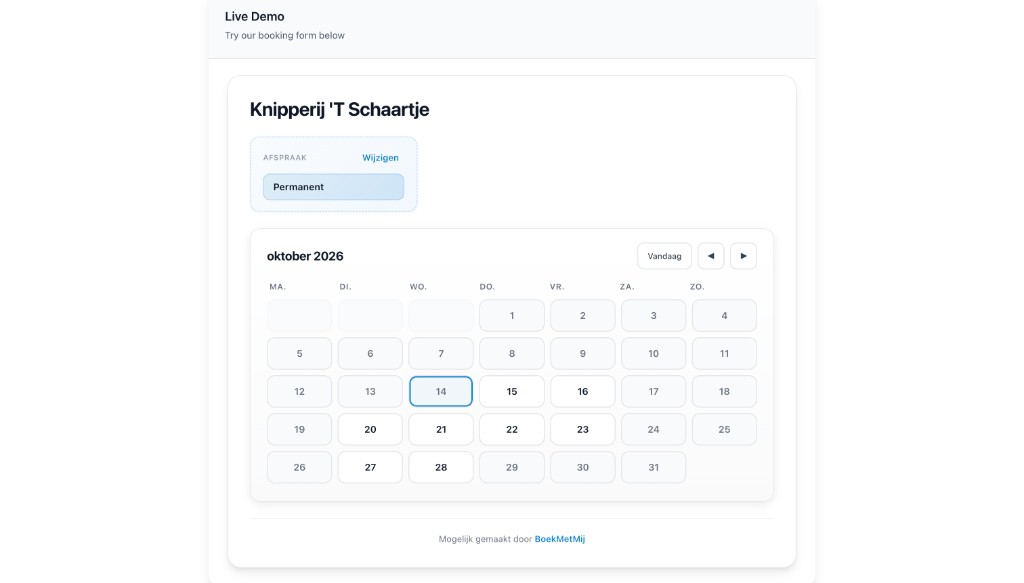
Drop the booking form into an existing site. The widget loads your services and real availability, walks the client through confirm, and lands them on a thank-you state without leaving your layout.
Hosted page
No site? No problem. Turn on a hosted reservation page with its own link, same flow as the embed, ready to paste into bio links or WhatsApp.
Live booking widget (embed or hosted page)
Stack
How I built it
The app is Laravel with Livewire for both the owner dashboard and the public booking UI, so validation and slot logic stay on the server and the forms still feel quick on mobile. Availability is computed from rules (hours, service length, existing bookings, time off), not hand-edited cells, which keeps double bookings out of the picture.
Bookings trigger a small event pipeline: confirmation and cancellation emails, optional notifications to the shop, and clear states in the admin calendar. Organizations can have multiple forms, multiple staff, and API access where integrations need it.
The marketing site and product share one design language, with Dutch and English throughout, because most early users are local businesses that want clients to book in two clicks, not learn another tool.
Next project
BrickID.app
A LEGO catalog browser with photo scan, search, collector tools, and a mobile companion. Built for fun in 2026.
Continue reading